
Secure continuity of your business

Cybersecurity controls (defensive and offensive)

Transforming security strategy into operational, measurable, and auditable controls
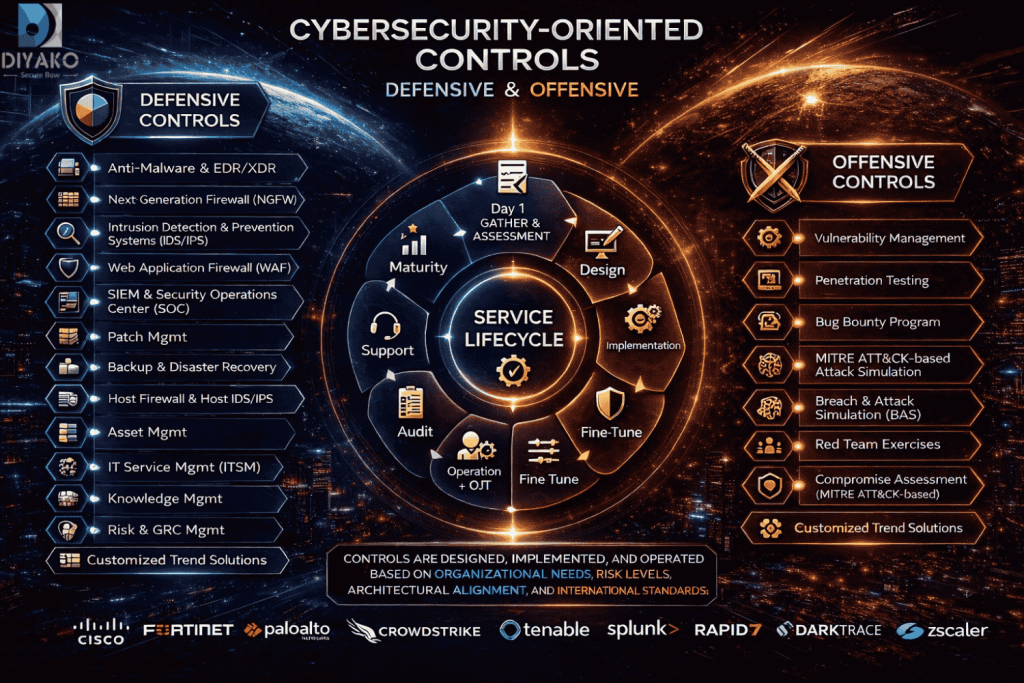
Defensive & Offensive Controls

Cybersecurity controls (defensive and offensive)

Translate security strategy into operational, measurable, and auditable controls. In mature organizations, cybersecurity does not remain solely at the policy and architectural level, but is designed, implemented, and managed as a set of executive, operational, and risk-based controls across the organization.

Security controls are the connecting link between security architecture, risk management, and security operations, ensuring that security requirements are actually implemented in the organization's infrastructure, systems, and processes.

At Diyako Secure Bow , cybersecurity controls are designed, implemented, secured, operated, and monitored using a needs-based, risk-based, standards-based, and vendor-neutral approach. This approach ensures that the organization has documented, effective, measurable, and defensible controls at all times.

Common challenges of organizations

Deploying security tools without understanding the real need
Lack of integration between controls and processes
Lack of connection between risks and implemented controls
Configuration errors (Misconfiguration)
Weak documentation and lack of preparation for audits
Implementing controls without a clear operating model
Result: Multiple tools + ineffective security + lack of audit readiness

Cybersecurity Controls Solution Delivery Model

1. Needs analysis , Current status and security gap

In this phase, the required controls are extracted based on the actual needs of the organization, the current situation, and risk analysis.

Implementation steps

• Gathering technical and business requirements

• As-Is Assessment

• Identifying gaps (Gap Analysis)

• Analysis of threats and attack scenarios

• Prioritization based on criticality level

2. Engineering design Security Controls (Control Engineering)

In this phase, controls are designed in a structured, measurable, and risk-based manner.

Implementation principles

• Any specific risk-based control

• Aligned with cybersecurity architecture

• Monitorable and measurable effectiveness

• Documented and auditable

Aggressive controls

Offensive Controls

In this area, aggressive controls are implemented with the aim of identifying weaknesses before the attacker:

  • Vulnerability Management
  • Penetration Testing
  • Bug Bounty Program
  • Attack simulation based on the MITRE ATT&CK framework
  • Breach & Attack Simulation (BAS)
  • Attack Surface Management (ASM)
  • Red Team Exercise
  • Compromise Assessment

Defensive controls

Defensive Controls

In this area, all processes, tools, and activities related to preventing, identifying, and responding to threats are designed and implemented:

  • Antimalware and Endpoint Detection and Response (EDR/XDR) systems
  • Next-generation firewall (NGFW)
  • Intrusion Detection and Prevention Systems (IDS/IPS)
  • Web Application Firewall (WAF)
  • Security Event Management & Operations Center (SIEM & SOC)
  • Patch Management
  • Asset Management
  • Risk & Compliance Management (Risk & GRC Management)
  • Backup & Disaster Recovery
  • Host Security Controls (Host Firewall & Host IDS/IPS)
  • Change Management
  • IT Service Management (ITSM)
  • Knowledge Management
  • Incident Response Team (CSIRT)
  • Other controls tailored to the organization's needs
۱

Implementation, security and integration

  • Design and implementation of solutions
  • Secure Configuration
  • Hardening & Fine-Tuning
  • Integration with infrastructure and systems
  • Connecting to the Security Operations Center
۲

Operation

  • Continuous monitoring and surveillance
  • Event analysis
  • Manage alerts
  • Continuous improvement of controls
۳

Documentation, Auditing and Compliance

  • Technical and executive documentation
  • Auditable evidence
  • Mapping Risk to Controls
  • Preparation for internal audits and third-party assessments
۴

Procurement and selection of solutions (Vendor-Neutral Approach)

Selecting tools and solutions based on:

  • Organizational requirements
  • Risk level
  • Security architecture
  • Organizational maturity
  • Legal requirements and standards

Nor is there any affiliation with a specific brand.

Key outputs

Design and document security controls
Mapping Risk to Controls
Executive and management reports
Audit and compliance documentation
Controls maturity model
Diyako Secure Bow Logo

Added value of Diaco's safe bow

Turning security into real operational controls
Reducing implementation errors
Integrating security, architecture, and operations
Establish auditable and defensible controls
Increasing the effectiveness of security operations
Diyako Secure Bow Logo

The result of this service for your organization

Real reduction of cyber risks
Increasing cybersecurity maturity
Full preparation for audits and legal requirements
Cost optimization
Data-driven decision-making

Are you ready to start?

To assess your current situation and receive a customized security roadmap, contact Diaco Secure Arc's Customer Relationship Management (AM) experts.

021-91691692 extension 1